
(Deutsch) Ständig müde? Was Dir Deine Energie raubt und wie Du sie auflädst

Zeichnung einer Frau, die keine Energie hat und müde ist

Always Tired? What’s Draining Your Energy – and How to Recharge

by Bettina Bonkas – English | Coaching | Resilience + Improvisation | Hypnosis
Reading time: approx. 7 minutes

You may know the feeling: you’re actually getting enough sleep, you generally eat well and you exercise fairly regularly. Perhaps you even know what’s currently getting to you – an annoying conflict, a project, a situation that’s on your mind. By the evening, you feel completely drained – and by evening, I don’t mean just before bedtime, but several hours earlier.

Why? You do look after yourself. So what is draining your energy – and how can you recharge?

A client put it like this during a coaching session:

“Bettina, I get enough sleep, I eat well and I exercise regularly. Yes, things haven’t been going well with a colleague for some time, but why am I still constantly exhausted?”

What’s going on, what you can do about it & an example from my coaching practice

“Why am I constantly exhausted?” – A question many of us can relate to. In my video, we take a look at where our energy comes from (very simply put), what drains it and where we can get energy from – with practical tips that you can put into practice straight away.

It’s also worth staying with this blog post. You’ll find interesting explanations to help you understand yourself better, practical tips you can use immediately, and a real-life example from my coaching practice.

Video – approx. 13 minutes (English):

Why Stress Drains Your Energy and How You Can Recharge

Let’s go back to my coaching client and her question:

“… Yes, things haven’t been going well with a colleague for some time, but why am I still constantly exhausted?”

The answer may have less to do with your discipline than you think – and more to do with your mitochondria, tiny structures inside your cells that you may never have heard of.

This is what Dr Martin Picard focuses on in his work. He is a stress and ageing researcher at Columbia University and was a guest on The Diary of a CEO podcast. He explains where our energy comes from and why sometimes it simply isn’t enough, no matter how hard we try.

In this post, I’ll share the most interesting insights from the podcast – but above all, what you can do yourself to recharge your energy. 🙂

Gluehlampe, die raucht

Your energy budget: a simple way of looking at it

Dr Picard likes to compare it to an electrical circuit: if you put too much voltage through it, resistance increases until the system overheats. The same applies to your energy: putting more in – for example, through constant self-optimisation – doesn’t automatically mean better performance.

This principle also applies to what you eat. If you eat a very large amount at once, for example, your body first has to process it. If the system is overloaded, the result is sluggishness rather than strength.

You may know the feeling: too much food, especially heavy food, leaves you tired and sluggish. But too much exercise can also backfire, leaving us feeling more fatigued rather than energized. Stress also puts a lot of pressure on your energy budget – except that the energy doesn’t go into digestion. It goes into keeping you on alert.

Mitochondria

Responsible for this are tiny power stations found in practically every cell of your body: mitochondria. They convert nutrients from our food and oxygen into a form of energy that our cells can use. They supply, for example, our heart, brain and muscle cells with energy.

But mitochondria don’t just produce energy. They also process information about stress and exhaustion – and even about purpose.

Dr Picard’s research shows that people with a strong sense of purpose have more efficient mitochondria.

For the scientist, mitochondria are almost like a small organ of their own within each cell – one that helps determine how much energy is available to you.

Your body is constantly redistributing energy, because our energy reserves – a bit like a battery – are not unlimited. If one area needs more, for example to deal with stress, another gets less.

Your mind is tired. Your body actually is too.

Fortunately, there are ways to replenish your energy budget.

Source: Bobba-Alves, Juster & Picard (2022), “The energetic cost of allostasis and allostatic load”, Psychoneuroendocrinology
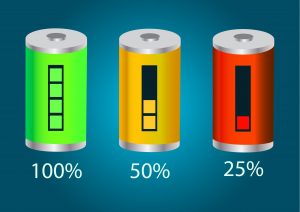

Bild von 3 Batterien in unterschiedlichem Ladezustand Recharging

Four levers to replenish your energy budget

Four different levers affect the same place: your mitochondria – where energy is produced.

Exercise (1) stimulates the development of new, more efficient mitochondria in the muscles, according to Dr Picard. Nutrition (2) provides the fuel that the mitochondria process. Under stress (3), according to Dr Picard, a greater proportion of their output goes towards keeping the body on alert, leaving less available for other functions. And meaning (4) is linked in his research to better mitochondrial function.

Let’s take a closer look at the four areas where you can directly influence your energy budget. The good news: none of them requires perfection.


1. Exercise – how it strengthens your mitochondria and your energy

According to Dr Picard, regular exercise can significantly increase the capacity of your muscle mitochondria – in some cases even doubling it.

The important thing is that this effect doesn’t come from simply getting out of breath. It happens because regular exercise gives your body a signal, over days and weeks, to build more and more efficient power stations.

The result: you have more energy.

Source: The Diary of a CEO, Dr Martin Picard in conversation with Steven Bartlett

⇒ The good news is: you don’t have to run a marathon. Regularity matters more than intensity. Every step counts. 🙂


2. Nutrition – listening to your body instead of constantly refuelling

Large amounts of food at once, or highly processed foods, can overload your body’s capacity to process them. That’s why you may feel sluggish afterwards rather than energised.

I notice this with our cat, too: she’s definitely more sluggish after eating a lot. 😉

What matters isn’t just what you eat, but also when you eat.

Having conscious breaks between meals, rather than constantly snacking, gives your digestive system time to recover.

Intermittent fasting – for example, eating within a fixed 8- to 10-hour window and then taking a corresponding break – builds on this principle, but goes considerably further.

Many people who have switched to intermittent fasting find that it works well for them, says Dr Picard. His message, however, isn’t that everyone should fast. It is:

Find out what way of eating works well for your body. What weighs you down, and what nourishes you?

Source: Huberman Lab. (15 December 2025). Improve Energy & Longevity by Optimizing Mitochondria | Dr Martin Picard (Episode 259) [Audio podcast]. Apple Podcasts.

A note on eating for comfort or distraction

Pure self-discipline probably won’t get everyone very far here.

If it did, most of us would eat a largely healthy diet, because most of us already know what we should be doing. But people are more complicated than that.

If you notice that, despite your best intentions, you keep reaching for food even though you know it drains your energy, there is usually something else behind it.

A good moment to pause and ask yourself: Am I really looking for energy right now – or am I looking for comfort, distraction or a break?

Sometimes asking that question alone is enough to make a difference. Sometimes, though, it helps to get an outside perspective.


3. Stress – the lever with the biggest impact

One important point: not all stress is a problem.

Short-term stress can actually strengthen your system. Dr Picard clearly distinguishes between acute and chronic stress. The problem starts when stress continues for a long time without genuine recovery in between.

Dr Picard and his team found that stress hormones can increase the energy use of our cells by around 60%.

Grey hair

An interesting example from Dr Picard’s research shows just how deeply stress can affect us: grey hair.

Individual hairs record what has happened in the body – rather like tree rings.

In a study from Dr Picard’s lab (Rosenberg et al., 2021), there was a particularly striking case: in one woman, a section of grey hair corresponded with two particularly stressful months: a separation, moving house and looking for a new job.

When her life became calmer again, the colour returned in that section of hair.

(This only works within a particular time window, usually when greying has only just begun, and it also depends on age.)

Concentration, Patience and Good Mood

What applies to hair often applies to concentration, patience and a good mood too: these are often among the first things to be “cut back” when we are under chronic stress. The body focuses on what it considers essential. – Sorry, but apparently a good mood doesn’t make the list. 🙁

Source: The Diary of a CEO, Dr Martin Picard in conversation with Steven Bartlett

Eine Frau die fuer Power Posing - Mindset & Embodiment steht

3 exercises for greater calm and inner peace

1. Mini meditations

“Three minutes of meditation every day is more effective than occasional long meditation sessions. Consistency makes the difference.”

(Jess Henley, psychotherapist with a private clinic, in Focus and Inner Calm Amid Digital Overload”)

Take two minutes here and there to pay attention to your breathing and posture. Breathe in through your nose and out through your mouth.

(From “Psychological Immune Systems: Tips for Boosting Resilience”)

2. A posture check

Unobtrusively, without taking any extra time – in meetings or while working at your computer.

Sit upright, with your shoulders relaxed and slightly back. Open up your chest and keep your arms slightly away from your body, with your palms facing outwards. Breathe into your abdomen.

Then change position: bring your shoulders forwards, slightly close your chest, keep your arms close to your body and turn your palms inwards.

Alternate between the two positions and finish with the relaxed, open position.

If you’re in a meeting, skip the position changes and simply pay attention to your posture: sit with an open chest and relaxed shoulders.

(From “Power Posing – Mindset & Embodiment”)

3. Don’t forget to laugh

“A smile can positively influence your mood and promote positive feelings.” (From Lachen macht gesund”)

Ein lachender gezeichneter Mund

Note

Too much social media can also leave us feeling like it’s all a bit “too much” and contribute to stress. In my video and blog post, “No Motivation? What Dopamine Has to Do with It”, you’ll find some background information and tips on how to boost your motivation.


4. Meaning and connection – the underestimated lever

Picard describes how a strong sense of meaning and purpose may be linked to better energy supply in the body.

People who know their “why” seem to use their energy more efficiently than people who feel chronically overwhelmed or like their lives have no meaning.

This doesn’t surprise me.

My father travelled around Germany as an eyewitness to history. At the age of 90, he took the train from Frankfurt to Berlin in the morning and travelled back again in the afternoon. Working with young people in particular gave him a great deal of energy.

One of my clients had a demanding job at a bank and also volunteered at a hospice. She summed up her commitment like this:

“My work there gives me so much. It keeps me grounded.”

Meaning isn’t a soft concept. It seems to have a measurable effect on your energy levels.

It doesn’t have to come from your job. The things we do alongside our main work can also give us a great deal.

Source: The Diary of a CEO, chapters “Why Meaningful Goals Become Magnets for Your Energy” and “Does Having a Purpose Improve Mitochondrial Function?”


Please note

This post is not a substitute for medical or therapeutic advice. Persistent exhaustion can have many different causes – sometimes seeking professional support is the right next step.


A real-life example: exhausted despite “doing everything right”

Let’s go back to the client I mentioned earlier.

She came to me feeling exhausted – despite getting enough sleep, eating consciously and exercising regularly.

Of course, she knew about the conflict with her colleague. It was on her mind regularly.

What she didn’t realise was just how much energy it was actually draining from her.

Her nervous system was so often in a state of alert that she had become used to it. Her energy budget was quietly being channelled into dealing with stress.

(Of course, there were other personal issues involved too – it’s rarely just one thing. But going into those would take us too far here.)

Our approach

Understanding the psychological foundations was very important to her, as was understanding that different personality types have different communication styles and needs.

She herself was more factual and rational, focused on the task at hand. Her colleague, on the other hand, was more relationship-oriented, but also rather emotional. She, too, of course, brought her own history into the situation.

However, the most important point for my client was something else: recognising her own value – including in the way she treated herself.

That’s what we worked on: taking a clear position, setting boundaries and building in short moments of recovery throughout the day. It was a process.

At the end, she said to me:

“I haven’t changed anything about my diet, and I still exercise, but I’ve learnt a lot. I’m kinder to myself now and take my own needs more seriously. I have more energy again.”

Often, the answer to exhaustion isn’t more self-optimisation. It’s how we deal with invisible, ongoing sources of stress.

Can't ist durchgestrichen, darunter steht Can

From my practice: feeling insecure when speaking English

Something else I notice again and again is that a lack of confidence when speaking English freely can also be a source of stress.

Whether consciously or in the background, it can drain a surprising amount of energy – energy that we then lack elsewhere.

In the following blog posts, you’ll find practical examples and the steps we took:

No Motivation? What Dopamine Has to Do With It
Boosting your Self-Confidence: 5 Strategies for Inner Strength


My takeaway for you

If you’re tired even though, on the surface, “everything is right”, there may be more going on.

Your body may be distributing its energy towards invisible stress that you’ve long since filed away as “normal”.

First step: Recognise that your exhaustion may be a signal from your body.

Second step: Look at where your energy is actually going – and where you are already strong in the four areas, and where there may be room for improvement.

Third step: Remind yourself that your system can learn and adapt – that’s what I mean by resilience – and put what you’ve learnt into practice. 🙂


A note on simplification

The mechanisms described here are complex and are the subject of ongoing research.

I have deliberately simplified them to make them accessible. Dr Picard himself also uses simple images and comparisons in the podcast, presumably to make the subject accessible to a wider audience.


Steven Bartlett’s podcast with Dr Martin Picard:
Anti-Aging Expert: This Reverses Gray Hair & Boosts Your Energy!

Frequently asked questions zu Dopamin, Motivation und Social Media Detox

Frequently asked questions about energy, stress and recovery

Why am I constantly tired even though I get enough sleep?

Exhaustion is often less about the amount of sleep you get and more about invisible, chronic stress, which puts an additional demand on your body’s energy.

Can stress really affect my energy?

Yes. In experiments by Dr Picard’s team, stress hormones increased the energy use of human cells by around 60%.

What does meaning have to do with energy?

According to Picard’s research, having a clear sense of meaning and purpose is linked to better energy supply in the body.

What can I do about chronic exhaustion when there seems to be no obvious reason?

If your sleep, nutrition and exercise are already in place, it may be worth looking at invisible, chronic stress – for example, unresolved conflicts or ongoing tension. Coaching can help you identify what may actually be behind it.


Would you like more energy and balance in everyday life?

If you feel that you’re constantly exhausted despite “doing many things right”, a conversation could be a useful next step.

I’d be happy to support you in finding out where your energy is actually going.

I offer Business & Life Coaching, Resilience Training and English Coaching – online and in person, for individuals and businesses.

Just get in touch – I’d love to hear from you.

Contact for businesses

Get in touch: bettina-bonkas.com/kontakt

Find out more about coaching: Life & Business Coaching

Find out more about resilience training: Resilience Training


Know someone who feels exhausted?

I’d be delighted if you shared this post.

You can also subscribe to my newsletter to receive new posts automatically.🙂

(Deutsch) Keine Motivation? Was Dopamin damit zu tun hat

Laufschuhe - Keine Motivation? Was Dopamin damit zu tun hat Dopamine & Motivation

No Motivation? What Dopamine Has to Do With It

by Bettina Bonkas – English | Coaching | Resilience + Improvisation | Hypnosis Reading time: approx. 8 minutes, Video: 12 minutes (English)

Sounds familiar? You want to exercise. Or finally get started on that project. Or go to bed earlier. But instead you scroll through Instagram, watch another episode on Netflix, or reach for some chocolate – even though you didn’t really want to.

And then comes that uncomfortable feeling: Why do I have so little discipline? You carry on and feel even worse.

Dr Anna Lembke – psychiatrist at Stanford University, Medical Director of Stanford Addiction Medicine, and bestselling author of Dopamine Nation – has a clear answer:

“You’re not unmotivated. You’re overstimulated.”
Dr. Anna Lembke, psychiatrist at Standford University

In an interesting interview with Mel Robbins, bestselling author and podcast host, Dr Lembke explains what happens in our brains – and how we can find our way back to motivation, energy and genuine enjoyment.

And exactly this question – how to move from knowing to doing — comes up again and again. Miriam from Dublin put it like this recently:

“Hi Bettina, I know it’s better for me to go for a run than to scroll on my phone. Why can’t I just do it?”

A powerful question that many of us can relate to. In my video I address exactly that: dopamine, brain basics, why social media can outsmart us so effectively – and what actually helps to get us moving:

Video – approx. 12 minutes, in English

No Motivation? What Dopamine Has to Do With It


Eine Hand hält ein gezeichnetes Gehirn

Dopamine and Motivation: What’s Happening in Your Brain

Dopamine is not a “happiness hormone” – that’s a widespread misconception.

Dopamine is the motivation hormone. It’s the signal our brain releases when it identifies something as important and worth pursuing. It tells us: I want that again. I need that.

Scientifically speaking: the more dopamine an experience triggers, the more strongly it’s stored as meaningful – and the stronger the urge to repeat it.

⇒ Dopamine doesn’t make us happy – it makes us hungry for more.

And that’s exactly the problem in today’s world.


The Pendulum: Pleasure and Pain Balance Each Other Out

Dr Lembke explains this principle through a vivid image: imagine a seesaw. On one side sits pleasure, on the other side discomfort. I prefer the metaphor of a pendulum – the principle is the same.

Our brain is designed to keep the pendulum horizontal: it constantly seeks balance.

Neuroscientists call this homeostasis – the natural resting state our brain continually strives to return to.

Like a thermostat that keeps a room at a steady temperature, our brain constantly regulates our internal states – body temperature, heart rate, hormone levels, and yes, our mood too.

What happens when we experience something pleasant? The pendulum swings towards pleasure and dopamine is released.

But then the brain steps in to correct: it sends little “gremlins” – Dr Lembke’s term – that settle on the pain side of the pendulum to bring it back into balance. The result? We feel worse afterwards than we did before. Restless. Empty. Slightly irritable. Drained.

And what do we do then? We reach again for the thing that gave us a brief good feeling.

The cycle starts over. What I’ve described above is, of course, a simplified version.

⇒ Important to note: this doesn’t apply equally to every pleasant experience.

Let’s look at that now.

Pendel - Erkärung für Dr. Anna Lembkes Homöostase (Gehirn)
AI generated


But Does This Apply to Everything – Even a Good Meal or a Film?

This is something I find really important.

Yes, the pendulum principle applies to all pleasant experiences in general. After a good meal or a film you’ve enjoyed, the brain returns to homeostasis. That’s normal and healthy – it’s what it’s built for.

⇒ The crucial difference lies in intensity.

Dr Lembke puts it this way: science uses dopamine as a kind of currency to measure the addictive potential of experiences. The more dopamine is released, and the faster it happens, the stronger the pull towards repetition.

A home-cooked meal that leaves us satisfied. A film that touches us. A good conversation that stirs something in us. These are natural rewards – they trigger moderate amounts of dopamine, the pendulum finds its balance quickly, and we’re not automatically left craving more.

Highly processed stimuli are a different matter: crisps seasoned so perfectly you can’t stop. Short video clips that get faster and more surprising with every scroll. Social media feeds algorithmically designed to keep you hooked. These stimuli activate the dopamine system with an intensity our brains simply weren’t built for.

The brain can actually tell the difference between a fulfilling evening with a good film and a reels loop – not morally, but neurologically. Our sense that one is somehow different from the other is scientifically correct.


Overstimulation: When the Brain Goes Numb

I find this particularly important.

When we repeatedly push our pendulum hard towards the pleasure side through fast, intense stimulation, the brain adapts. Over time, it needs more and more to generate the same feeling. Experts call this tolerance.

At the same time, our baseline shifts. What once felt “normal” now feels empty. What once brought joy now feels flat.

Our brain becomes increasingly addicted to novelty. Research shows that unpredictability and surprise activate the dopamine system particularly strongly. That’s precisely how social media algorithms are built. The thrill of the new. And because we become accustomed to ever more intense stimulation, we get bored more quickly – in real life too.

The result: concentration, genuine joy, motivation for tasks that require time and patience – all of it feels increasingly difficult.


Aufgeschlagenes Buch

Dr Lembke’s Own Story

What makes this interview special: Dr Lembke shares her own story.

The psychiatrist who works with addiction every day developed one herself –  to romance novels. In her book Dopamine Nation she writes about it: it started with the Twilight saga – “my gateway drug,” as she calls it. When she got a Kindle, she was grateful that no one could see the embarrassing covers. She read between patient appointments and stayed up later and later at night. What began as a harmless habit became, over more than two years, an increasingly consuming pattern.

Dr Lembke’s story shows: these brain mechanisms affect all of us. Even those who understand them best.

Source: Anna Lembke, “Dopamine Nation” and “Addicted to Dopamine” – UNSW Centre for Ideas


Why “Easy Dopamine” Becomes a Problem

Our brains were never designed for a world of constantly available, high-intensity rewards. In the past, pleasure required effort: foraging for food, hunting, building social bonds. All of that took time, energy, and commitment. But that’s exactly what humans were adapted for: making an effort was how you survived and moved forward. From an evolutionary perspective, the way our brains work makes perfect sense.

Today? A swipe of the thumb. A click. A scroll.

Social media, box sets, junk food, online shopping – all of it delivers fast, easy dopamine. And the more of it we get, the more we need to generate the same feeling. It’s like crisps or chocolate: stopping is hard.

At the same time, our capacity to find pleasure in simple things quietly diminishes – a conversation, a walk, quiet work that moves us forward.

The result: Everything important feels like an effort. Everything easy no longer feels quite good enough.

Dr Lembke calls this a kind of collective anhedonia: we unlearn how to feel joy.


Please note This post is not a substitute for therapy. Sometimes exhaustion or lack of drive runs deeper, and professional support is what’s needed.


-> By the way, it’s not always a lack of motivation. Sometimes the real issue is a deeper lack of energy. I’m currently working on a new article based on the latest mitochondrial research. You’ll find more details below.


Dopamine Detox: What It Does and How It Works

Dr Lembke recommends what she calls a “dopamine detox“: a deliberate break from whatever triggers your dopamine spiral.

This doesn’t mean stripping all pleasure from your life. It’s about targeted, time-limited pauses – ideally three to four weeks.

In practice, this might look like:

  • No scrolling through social media after waking up – put the phone away
  • Replacing binge-watching with conscious viewing (one episode instead of four)
  • Keeping your phone out of reach in the evening

What can support the process? Movement and exercise. They activate the dopamine system via the pain side of the pendulum: the effort pushes the pendulum briefly towards discomfort, but the brain responds with a dopamine release – without the subsequent crash. This actively supports the return to homeostasis.

The key message: discomfort is not a problem. It’s the signal that your brain is recalibrating.

Dr Lembke describes it this way: the pendulum needs to find its balance before we can experience genuine joy again. It might take a while – but it works.


Fahrradfahrer - Sport aktiviert Dopamin und fördert Motivation

Why Exercise and Challenge Activate Dopamine

Here’s where it gets particularly interesting: Dr Lembke explains that pain and challenge tip the pendulum in the opposite direction – towards discomfort. So far, so clear. But our clever brain responds by releasing dopamine to restore the balance.

This explains why exercise, cold water immersion, difficult tasks, or even challenging conversations often leave us feeling better than short-term distractions.

Not in spite of the discomfort. Because of it.


What This Has to Do With Resilience

In my work, I meet people who ask themselves: why is change so hard for me? Why can’t I get going, even when I know what’s good for me?

A lack of willpower is often not the real issue.

What’s more likely is that our nervous system has been trained towards easy rewards. And real change – in work, in relationships, in our own outlook – is rarely easy. It demands persistence, patience, and the ability to sit with discomfort.

But here’s the good news: the brain is capable of learning. That’s what we call neuroplasticity.

When we teach our brain again to reward patience — and to experience genuine effort as meaningful – it’s not just our motivation that changes. It changes how we relate to ourselves.

And that is resilience at its core: not the absence of difficulty, but the confidence that we can handle it.

And the beautiful thing is: with every challenge we work through, that confidence in ourselves grows more and more.


A quick note on simplification: When I talk about dopamine, serotonin and so on here, this is a deliberately simplified picture. Our brains are, of course, far more complex: neurotransmitters are never released in isolation, but work together across multiple systems at once, and each one has several functions rather than just the one it’s often credited with.

Dr Lembke has also, I suspect, deliberately chosen a simplified model to draw attention to the topic and make it accessible to a wider audience. I find her imagery genuinely helpful, because it gives you a real sense of what’s happening in the brain – even though the reality is, naturally, far more layered than that.


A Real-Life Example: From “I Can’t Do English” to Real Motivation

A client came to me because he needed English for his job: meetings with his UK team, presentations, international client contacts. He attended the coaching sessions, but nothing happened in between. The motivation simply wasn’t there.

What was really going on? A belief that had been with him since school: “I can’t do English.” His teacher had told him he should find a job that didn’t require English. That had stayed with him.

At the same time, his daily life looked like many of ours: phone first thing in the morning, a demanding day at work, evenings spent streaming and scrolling through sports news. His nervous system was chronically overstimulated –  there was no energy left for learning.

We worked on both: the belief and the overstimulation.

Every coaching session began with a two-minute meditation in English to bring his system down. We made sure he experienced small wins, so he could feel for himself: “Yes, I can.” And I explained what dopamine has to do with motivation and why his brain needed calm, not more stimulation. I brought stillness into our sessions, alongside real learning progress.

(On the topic of goal-setting, I’ve written a separate blog post: Step by Step Towards Your Goal)

The rest? It came almost naturally, because he could feel that it was doing him good. He started the day without his phone and read an English-language magazine (Business Spotlight) over his morning coffee instead. In the car, he listened to a podcast in English (English please!) – or simply music. In the evenings, he watched the news in English, and eventually series. Because he enjoyed it, not because he felt he “had to.”

His cycling trips stayed deliberately phone- and headphone-free: just him and the open road.

None of this happened overnight. But he became more focused, calmer, and more motivated. And he saw results that spurred him on to keep going.

Sometimes the real issue isn’t English at all. Sometimes it’s an old belief and a nervous system that’s simply too tired to learn.


My Conclusion and an Invitation to You

You are not too weak and you are not an exception. You live in a world that has become very good at hijacking your brain.

Recognising that is the first step.

The second step is to take a small pause and see what happens.

And the third step? Not to judge yourself when it doesn’t go perfectly. Dr Lembke herself – the expert on exactly this topic – is not immune to it either. That doesn’t make her less competent; on the contrary, it makes her credible.

And if you suspect that your exhaustion isn’t just about motivation, but that stress is quietly draining your energy, I’m currently writing a new article on exactly that. It’ll be published soon – you’ll find more information at the bottom of the page.

⇒ For more tips you can put into practice straight away, have a look at my blog post “Focus and Inner Calm Amid Digital Overload”.


The podcast episode with Mel Robbins and Dr. Anna Lembke: The Science of Self Control: Find Motivation, Build Willpower, and Increase Your Focus Book: Dr Anna Lembke – Dopamine Nation


Frequently asked questions zu Dopamin, Motivation und Social Media Detox

Frequently Asked Questions About Dopamine, Motivation and Dopamine Detox

What is dopamine and why does it matter for motivation? Dopamine is a neurotransmitter in the brain that drives motivation and initiative. It signals what’s worth pursuing and propels us to go after it.

What’s the difference between dopamine and happiness? Dopamine is not a happiness hormone – it’s a motivation hormone. It creates the desire for more, not a sense of contentment. Genuine contentment comes from other neurotransmitters, such as serotonin.

Why do I feel worse after scrolling than I did before? After a dopamine spike, the brain automatically corrects towards discomfort – that’s the “pain side of the pendulum.” The result: emptiness, restlessness, mild irritability. Not weakness but neurology.

What happens in the brain when we use too much social media? Social media is designed to activate the dopamine system with unpredictable, rapid stimulation. The brain adapts and needs ever more stimulation – everyday tasks start to feel dull and demanding by comparison.

Why have I lost my motivation? A common reason: overstimulation through fast rewards. When the brain has too many easy dopamine sources, it unlearns how to experience effort as worthwhile.

Can exercise really help with motivation problems? Yes – and in a rather particular way. Exercise activates dopamine via the “detour” of discomfort: the effort pushes the pendulum briefly towards pain, but the brain responds with dopamine – without the subsequent crash.

What does “dopamine detox” mean? A dopamine detox is a deliberate, time-limited break from activities that trigger fast dopamine release (e.g. social media, box sets, junk food). The goal: to recalibrate the brain so it can experience genuine joy and motivation again.

How long does a dopamine detox take? Dr Lembke recommends around four weeks for strong habits. Even shorter, conscious breaks (a week, a weekend) can have noticeable effects.


Would You Like More Energy and Motivation?

If you feel that you currently have little energy, motivation, or joy in your life, a conversation might be the most useful next step. Sometimes the search for the next dopamine hit isn’t the real challenge – it’s a signal that important needs aren’t being met. I’d be glad to help you get to the bottom of what’s going on.

I offer Business & Life Coaching, resilience training and English coaching – online and in person, for individuals and companies.

Just get in touch – I’d love to hear your story.

Contact for businesses

→ Get in touch: bettina-bonkas.com/kontakt

→ Find out more about coaching: Life & Business Coaching

→ Find out more about resilience training: Resilience Training


 Coming soon: Why you’re tired, even though you’re doing so much right

If you’re constantly tired despite eating well, exercising and looking after yourself, you’re not alone. Research into mitochondria offers new insights into why this happens – and four practical ways to restore your energy.

Subscribe to my newsletter (top right) and I’ll send you the article as soon as it’s published, together with future articles.

Do you know someone who’s feeling low on drive right now?

I’d be really happy if you shared this with them. And if you subscribe to my newsletter, you’ll receive my posts automatically. 🙂

Bettina Bonkas, Coaching + Training | Im Ärmchen 3, D-61273 Wehrheim im Taunus | Contact | Impressum | Data Protection | Datenschutz Cookie-Settings | Cookie-Einstellungen