

Always Tired? What’s Draining Your Energy – and How to Recharge
by Bettina Bonkas – English | Coaching | Resilience + Improvisation | Hypnosis
Reading time: approx. 7 minutes
You may know the feeling: you’re actually getting enough sleep, you generally eat well and you exercise fairly regularly. Perhaps you even know what’s currently getting to you – an annoying conflict, a project, a situation that’s on your mind. By the evening, you feel completely drained – and by evening, I don’t mean just before bedtime, but several hours earlier.
Why? You do look after yourself. So what is draining your energy – and how can you recharge?
A client put it like this during a coaching session:
“Bettina, I get enough sleep, I eat well and I exercise regularly. Yes, things haven’t been going well with a colleague for some time, but why am I still constantly exhausted?”
What’s going on, what you can do about it & an example from my coaching practice
“Why am I constantly exhausted?” – A question many of us can relate to. In my video, we take a look at where our energy comes from (very simply put), what drains it and where we can get energy from – with practical tips that you can put into practice straight away.
It’s also worth staying with this blog post. You’ll find interesting explanations to help you understand yourself better, practical tips you can use immediately, and a real-life example from my coaching practice.
Video – approx. 13 minutes (English):
Why Stress Drains Your Energy and How You Can Recharge
Let’s go back to my coaching client and her question:
“… Yes, things haven’t been going well with a colleague for some time, but why am I still constantly exhausted?”
The answer may have less to do with your discipline than you think – and more to do with your mitochondria, tiny structures inside your cells that you may never have heard of.
This is what Dr Martin Picard focuses on in his work. He is a stress and ageing researcher at Columbia University and was a guest on The Diary of a CEO podcast. He explains where our energy comes from and why sometimes it simply isn’t enough, no matter how hard we try.
In this post, I’ll share the most interesting insights from the podcast – but above all, what you can do yourself to recharge your energy. 🙂
Your energy budget: a simple way of looking at it
Dr Picard likes to compare it to an electrical circuit: if you put too much voltage through it, resistance increases until the system overheats. The same applies to your energy: putting more in – for example, through constant self-optimisation – doesn’t automatically mean better performance.
This principle also applies to what you eat. If you eat a very large amount at once, for example, your body first has to process it. If the system is overloaded, the result is sluggishness rather than strength.
You may know the feeling: too much food, especially heavy food, leaves you tired and sluggish. But too much exercise can also backfire, leaving us feeling more fatigued rather than energized. Stress also puts a lot of pressure on your energy budget – except that the energy doesn’t go into digestion. It goes into keeping you on alert.
Mitochondria
Responsible for this are tiny power stations found in practically every cell of your body: mitochondria. They convert nutrients from our food and oxygen into a form of energy that our cells can use. They supply, for example, our heart, brain and muscle cells with energy.
But mitochondria don’t just produce energy. They also process information about stress and exhaustion – and even about purpose.
Dr Picard’s research shows that people with a strong sense of purpose have more efficient mitochondria.
For the scientist, mitochondria are almost like a small organ of their own within each cell – one that helps determine how much energy is available to you.
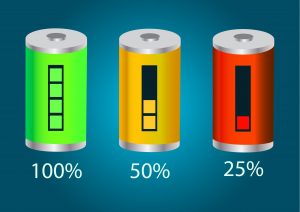
⇒ Your body is constantly redistributing energy, because our energy reserves – a bit like a battery – are not unlimited. If one area needs more, for example to deal with stress, another gets less.
Your mind is tired. Your body actually is too.
⇒ Fortunately, there are ways to replenish your energy budget.
Source: Bobba-Alves, Juster & Picard (2022), “The energetic cost of allostasis and allostatic load”, Psychoneuroendocrinology
 Recharging
Four levers to replenish your energy budget
Four different levers affect the same place: your mitochondria – where energy is produced.
Exercise (1) stimulates the development of new, more efficient mitochondria in the muscles, according to Dr Picard. Nutrition (2) provides the fuel that the mitochondria process. Under stress (3), according to Dr Picard, a greater proportion of their output goes towards keeping the body on alert, leaving less available for other functions. And meaning (4) is linked in his research to better mitochondrial function.
Let’s take a closer look at the four areas where you can directly influence your energy budget. The good news: none of them requires perfection.
1. Exercise – how it strengthens your mitochondria and your energy
According to Dr Picard, regular exercise can significantly increase the capacity of your muscle mitochondria – in some cases even doubling it.
The important thing is that this effect doesn’t come from simply getting out of breath. It happens because regular exercise gives your body a signal, over days and weeks, to build more and more efficient power stations.
The result: you have more energy.
Source: The Diary of a CEO, Dr Martin Picard in conversation with Steven Bartlett
⇒ The good news is: you don’t have to run a marathon. Regularity matters more than intensity. Every step counts. 🙂
2. Nutrition – listening to your body instead of constantly refuelling
Large amounts of food at once, or highly processed foods, can overload your body’s capacity to process them. That’s why you may feel sluggish afterwards rather than energised.
I notice this with our cat, too: she’s definitely more sluggish after eating a lot. 😉
What matters isn’t just what you eat, but also when you eat.
Having conscious breaks between meals, rather than constantly snacking, gives your digestive system time to recover.
Intermittent fasting – for example, eating within a fixed 8- to 10-hour window and then taking a corresponding break – builds on this principle, but goes considerably further.
Many people who have switched to intermittent fasting find that it works well for them, says Dr Picard. His message, however, isn’t that everyone should fast. It is:
⇒ Find out what way of eating works well for your body. What weighs you down, and what nourishes you?
Source: Huberman Lab. (15 December 2025). Improve Energy & Longevity by Optimizing Mitochondria | Dr Martin Picard (Episode 259) [Audio podcast]. Apple Podcasts.
A note on eating for comfort or distraction
Pure self-discipline probably won’t get everyone very far here.
If it did, most of us would eat a largely healthy diet, because most of us already know what we should be doing. But people are more complicated than that.
If you notice that, despite your best intentions, you keep reaching for food even though you know it drains your energy, there is usually something else behind it.
⇒ A good moment to pause and ask yourself: Am I really looking for energy right now – or am I looking for comfort, distraction or a break?
Sometimes asking that question alone is enough to make a difference. Sometimes, though, it helps to get an outside perspective.
3. Stress – the lever with the biggest impact
One important point: not all stress is a problem.
Short-term stress can actually strengthen your system. Dr Picard clearly distinguishes between acute and chronic stress. The problem starts when stress continues for a long time without genuine recovery in between.
Dr Picard and his team found that stress hormones can increase the energy use of our cells by around 60%.
Grey hair
An interesting example from Dr Picard’s research shows just how deeply stress can affect us: grey hair.
Individual hairs record what has happened in the body – rather like tree rings.
In a study from Dr Picard’s lab (Rosenberg et al., 2021), there was a particularly striking case: in one woman, a section of grey hair corresponded with two particularly stressful months: a separation, moving house and looking for a new job.
When her life became calmer again, the colour returned in that section of hair.
(This only works within a particular time window, usually when greying has only just begun, and it also depends on age.)
Concentration, Patience and Good Mood
What applies to hair often applies to concentration, patience and a good mood too: these are often among the first things to be “cut back” when we are under chronic stress. The body focuses on what it considers essential. – Sorry, but apparently a good mood doesn’t make the list. 🙁
Source: The Diary of a CEO, Dr Martin Picard in conversation with Steven Bartlett

3 exercises for greater calm and inner peace
1. Mini meditations
“Three minutes of meditation every day is more effective than occasional long meditation sessions. Consistency makes the difference.”
(Jess Henley, psychotherapist with a private clinic, in “Focus and Inner Calm Amid Digital Overload”)
Take two minutes here and there to pay attention to your breathing and posture. Breathe in through your nose and out through your mouth.
(From “Psychological Immune Systems: Tips for Boosting Resilience”)
2. A posture check
Unobtrusively, without taking any extra time – in meetings or while working at your computer.
Sit upright, with your shoulders relaxed and slightly back. Open up your chest and keep your arms slightly away from your body, with your palms facing outwards. Breathe into your abdomen.
Then change position: bring your shoulders forwards, slightly close your chest, keep your arms close to your body and turn your palms inwards.
Alternate between the two positions and finish with the relaxed, open position.
If you’re in a meeting, skip the position changes and simply pay attention to your posture: sit with an open chest and relaxed shoulders.
(From “Power Posing – Mindset & Embodiment”)
3. Don’t forget to laugh
“A smile can positively influence your mood and promote positive feelings.” (From “Lachen macht gesund”)

Note
Too much social media can also leave us feeling like it’s all a bit “too much” and contribute to stress. In my video and blog post, “No Motivation? What Dopamine Has to Do with It”, you’ll find some background information and tips on how to boost your motivation.
4. Meaning and connection – the underestimated lever
Picard describes how a strong sense of meaning and purpose may be linked to better energy supply in the body.
People who know their “why” seem to use their energy more efficiently than people who feel chronically overwhelmed or like their lives have no meaning.
This doesn’t surprise me.
My father travelled around Germany as an eyewitness to history. At the age of 90, he took the train from Frankfurt to Berlin in the morning and travelled back again in the afternoon. Working with young people in particular gave him a great deal of energy.
One of my clients had a demanding job at a bank and also volunteered at a hospice. She summed up her commitment like this:
“My work there gives me so much. It keeps me grounded.”
⇒ Meaning isn’t a soft concept. It seems to have a measurable effect on your energy levels.
It doesn’t have to come from your job. The things we do alongside our main work can also give us a great deal.
Source: The Diary of a CEO, chapters “Why Meaningful Goals Become Magnets for Your Energy” and “Does Having a Purpose Improve Mitochondrial Function?”
Please note
This post is not a substitute for medical or therapeutic advice. Persistent exhaustion can have many different causes – sometimes seeking professional support is the right next step.
A real-life example: exhausted despite “doing everything right”
Let’s go back to the client I mentioned earlier.
She came to me feeling exhausted – despite getting enough sleep, eating consciously and exercising regularly.
Of course, she knew about the conflict with her colleague. It was on her mind regularly.
What she didn’t realise was just how much energy it was actually draining from her.
Her nervous system was so often in a state of alert that she had become used to it. Her energy budget was quietly being channelled into dealing with stress.
(Of course, there were other personal issues involved too – it’s rarely just one thing. But going into those would take us too far here.)
Our approach
Understanding the psychological foundations was very important to her, as was understanding that different personality types have different communication styles and needs.
She herself was more factual and rational, focused on the task at hand. Her colleague, on the other hand, was more relationship-oriented, but also rather emotional. She, too, of course, brought her own history into the situation.
However, the most important point for my client was something else: recognising her own value – including in the way she treated herself.
That’s what we worked on: taking a clear position, setting boundaries and building in short moments of recovery throughout the day. It was a process.
At the end, she said to me:
“I haven’t changed anything about my diet, and I still exercise, but I’ve learnt a lot. I’m kinder to myself now and take my own needs more seriously. I have more energy again.”
Often, the answer to exhaustion isn’t more self-optimisation. It’s how we deal with invisible, ongoing sources of stress.

From my practice: feeling insecure when speaking English
Something else I notice again and again is that a lack of confidence when speaking English freely can also be a source of stress.
Whether consciously or in the background, it can drain a surprising amount of energy – energy that we then lack elsewhere.
In the following blog posts, you’ll find practical examples and the steps we took:
In this article, you’ll also learn how quick, easily accessible sources of dopamine – such as social media, TV series, junk food or online shopping – can contribute to feelings of exhaustion and tiredness.
My takeaway for you
If you’re tired even though, on the surface, “everything is right”, there may be more going on.
Your body may be distributing its energy towards invisible stress that you’ve long since filed away as “normal”.
First step: Recognise that your exhaustion may be a signal from your body.
Second step: Look at where your energy is actually going – and where you are already strong in the four areas, and where there may be room for improvement.
Third step: Remind yourself that your system can learn and adapt – that’s what I mean by resilience – and put what you’ve learnt into practice. 🙂
A note on simplification
The mechanisms described here are complex and are the subject of ongoing research.
I have deliberately simplified them to make them accessible. Dr Picard himself also uses simple images and comparisons in the podcast, presumably to make the subject accessible to a wider audience.
Steven Bartlett’s podcast with Dr Martin Picard:
Anti-Aging Expert: This Reverses Gray Hair & Boosts Your Energy!
Frequently asked questions about energy, stress and recovery
Why am I constantly tired even though I get enough sleep?
Exhaustion is often less about the amount of sleep you get and more about invisible, chronic stress, which puts an additional demand on your body’s energy.
Can stress really affect my energy?
Yes. In experiments by Dr Picard’s team, stress hormones increased the energy use of human cells by around 60%.
What does meaning have to do with energy?
According to Picard’s research, having a clear sense of meaning and purpose is linked to better energy supply in the body.
What can I do about chronic exhaustion when there seems to be no obvious reason?
If your sleep, nutrition and exercise are already in place, it may be worth looking at invisible, chronic stress – for example, unresolved conflicts or ongoing tension. Coaching can help you identify what may actually be behind it.
Would you like more energy and balance in everyday life?
If you feel that you’re constantly exhausted despite “doing many things right”, a conversation could be a useful next step.
I’d be happy to support you in finding out where your energy is actually going.
I offer Business & Life Coaching, Resilience Training and English Coaching – online and in person, for individuals and businesses.
Just get in touch – I’d love to hear from you.
Contact for businesses
→ Get in touch: bettina-bonkas.com/kontakt
→ Find out more about coaching: Life & Business Coaching
→ Find out more about resilience training: Resilience Training
Know someone who feels exhausted?
I’d be delighted if you shared this post.
You can also subscribe to my newsletter to receive new posts automatically.🙂
 Dopamine & Motivation